


 Download PDF
TPS Pro managed the first biennial Monitoring Report of the Sustainable Urban Mobility Plan for the Unione Montana Spettabile Reggenza dei Sette Comuni, published in May 2026, two years following the Plan’s approval. The work, conducted in full compliance with the national guidelines of Ministerial Decree (D.M.) 397/2017 and Ministerial Decree (D.M.) 396/2019, implemented the provisions of Chapter 17 of the SUMP, translating the Plan’s methodological framework into a periodic monitoring system based on context, implementation, and output indicators.

The approach utilized involved classifying the indicators into three categories, designed to efficiently organize data collection: Type A indicators, which can be estimated without the support of a traffic model; Type B indicators, which require an update of the simulation model; and Type C indicators, relating to the socioeconomic and demographic context and populated by institutional sources such as ISTAT, ARPAV, and ACI. An annual update was established for Type A and C indicators, and a biennial update for Type B indicators, in line with the frequency recommended by the Eltis Guidelines for mid-term monitoring.

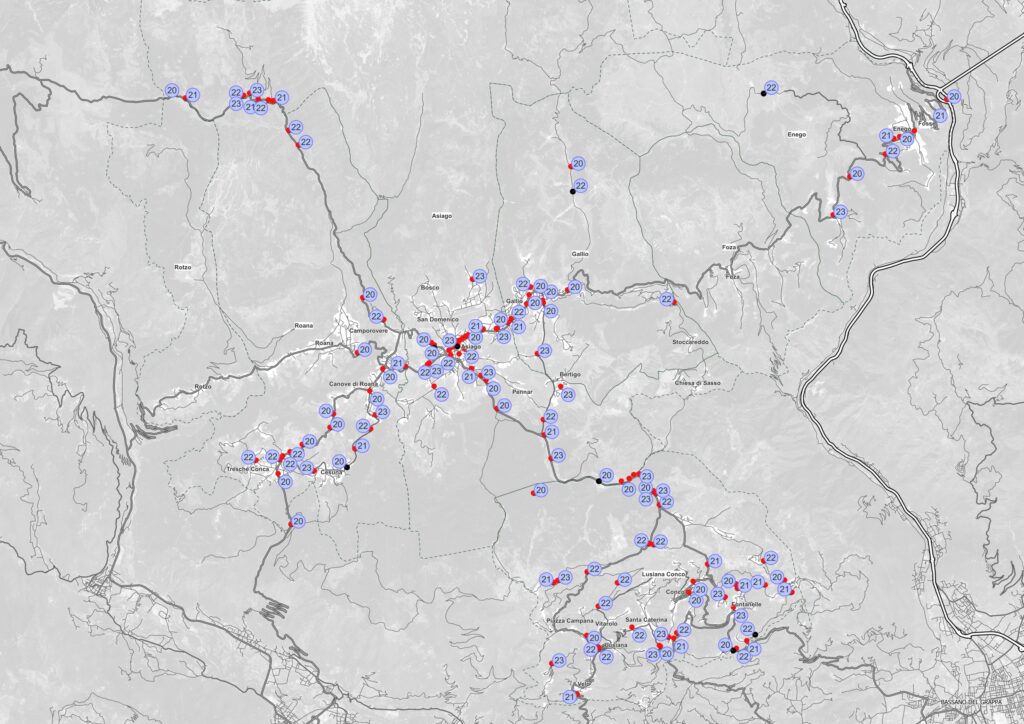
To update the Type B indicators, two new field survey campaigns were designed and conducted—one in summer and one in winter—replicating the 17 key road network nodes previously investigated during the drafting phase of the SUMP (13 mid-block sections and 4 intersections), in addition to a parking survey across 10 areas. Vehicle counts were performed using Techtronic Compact-1000 Doppler radars and Miovision Scout video systems, equipment that ensures non-invasive surveys and accurate flow classification even on multi-lane sections. Compared to the original 2021 campaign, the peak traffic days were selected for monitoring—the August Bank Holiday (Ferragosto) long weekend in 2025 for the summer, and the Epiphany long weekend in 2026 for the winter. This methodological choice was designed to provide the Unione Montana with a more representative overview of the actual local bottlenecks during periods of peak tourist pressure.
The technical framework was complemented by a public participation process, which included a kick-off meeting with the Plateau municipalities in October 2025 and a public presentation in Asiago in June 2026. Additionally, a press review analysis was conducted, highlighting road safety, interurban public transport, and the cycling network as priority issues for both citizens and local administrations.
Data processing highlighted a generalized increase in vehicle flows compared to 2021, which was particularly pronounced at the access points to the Plateau, alongside significant growth in bicycle use during the summer period. The developed cordon analyses show a balance between inbound and outbound trips on Fridays and Saturdays, with an outbound surplus on Sundays, consistent with the conclusion of short-term tourist stays. The simulation model was then recalibrated based on the new counts to estimate emission indicators (NOX, PM10, PM2,5, CO2) and congestion levels across the primary network.
The report includes two thematic deep-dives focusing on air quality and accident rates. For the former, data from the ARPAV monitoring station at Asiago Cima Ekar was integrated; this data shows concentrations well below the regulatory limits, but a number of ozone information threshold exceedances higher than the average of Venetian monitoring stations in 2024. For the latter, the 2010–2023 ISTAT historical series was reconstructed, confirming the seasonal nature of traffic accidents on the Plateau, which are concentrated in the summer months and on weekends.

This work confirms TPS Pro’s capability to support local authorities throughout the entire lifecycle of a SUMP: from building the analytical framework and calibrating simulation models to periodic monitoring and communicating results to citizens and stakeholders. In the case of the Altopiano dei Sette Comuni, these elements have clearly identified intervention priorities regarding ITS systems, park-and-ride facilities, and the completion of the cycling network.